
What is a B2B creator?
By Brendan Gahan · Updated
Definition
A B2B creator is a person who regularly publishes content for a professional audience, usually about their own field, and whose followers include people who make or influence business purchases. Many post on LinkedIn, and brands partner with them to reach and earn trust with specific buyers.
What does a B2B creator do?
A B2B creator publishes useful content for people in their field, and in doing so shapes what those people buy. Most built their authority off the platform first, as operators, founders, sellers, researchers or consultants. Their audience follows them for frameworks, career advice and answers to real work problems, not entertainment for its own sake.
Their value comes from who follows them, not how many. A former CFO with 20,000 followers who are mostly finance leaders can matter more to a software company than a celebrity with millions.
There are a lot more of them than there used to be. The number of creators on LinkedIn nearly doubled between 2021 and 2025, the company told Reuters. LinkedIn's Creator Marketplace now lets brands filter creators by how concentrated their audience is in an industry, job function or seniority level.
How is B2B creator marketing different from consumer influencer marketing?
B2C sells to one person, often on impulse. B2B sells to a committee, over months, to a small group of people who care about expertise more than entertainment.
The numbers behind that. A third of SMBs have more than six decision-makers, according to LinkedIn's survey of 4,287 SMB decision-makers. LinkedIn's B2B Institute estimates 95% of potential buyers aren't ready to buy today, so you have to stay top of mind to be the trusted name when they enter the market.
And buyers lean on creators heavily. In LinkedIn's research with GWI, 91% of tech buyers said they use industry influencers in their purchase journey. 82% of B2B buyers say creator content influences them, and industry experts are an effective influence for 55% of buyers, ahead of analysts and business leaders at 43% each. People trust people, not logos.
What are the types of B2B creators?
B2B creators are defined by what they do, not by how many people follow them. A practitioner can have 5,000 followers or 200,000. Most fall on a spectrum from operators to entertainers, with celebrities at the far end:
The lines blur. Plenty of practitioners are great content creators, and some personalities are genuine experts. Classify by the job you need done, not the follower count. I often cast a sharp practitioner next to a workplace comedian. One builds credibility. The other gets the message seen and shared.
Celebrities work when the idea comes first. In January 2025, my team at Creator Authority worked on Notion Faces, a first-of-its-kind LinkedIn influencer campaign. Faces let anyone draw a hand-drawn portrait of themselves in Notion's signature illustration style. We led the macro-creator partnerships, including Snoop Dogg, alongside dozens of LinkedIn creators. Snoop fit because the concept came first: a playful, visual new-year moment that a famous face could jump into naturally. Brands that start with a famous name and then hunt for an idea to wrap around it usually get an expensive post and not much else. Don't pitch a name. Pitch a direction.
Three more distinctions change how you work with them:
- Inside or outside. A brand's own leaders and employees can be creators too. LinkedIn says employees can extend a company's reach 12x beyond its company page. I like pairing them with independent creators, who carry trust because they aren't on the payroll.
- LinkedIn-native or cross-platform. Native creators know the feed: text, carousels and short video. Creators with big audiences on YouTube, TikTok or newsletters usually price higher, because they're fielding offers from everywhere.
- Broad or niche. Career and productivity voices reach more people for less. Niche operators in fields like cybersecurity or procurement cost more, because their audience has buying power.
Why do B2B creators matter?
B2B creators matter because buyers trust people more than brands, and they lean on creators at both ends of a purchase. They shape how a buyer frames the problem, and they help confirm the choice.
What kind of B2B creator content works?
Useful content that sounds like the creator, with the product in a supporting role. Here's what we've seen work:
- Useful beats interesting. People use LinkedIn to get ahead at work, earn more and build businesses. In one comparison from our playbook, a practical "how to get paid" post pulled 1.2 million views. An "interesting insights" post pulled 50,000. Ugly and useful beats beautiful and vague.
- Borrow what works. Every good creator has formats their audience already responds to. Slot your message into those instead of asking them to start from zero.
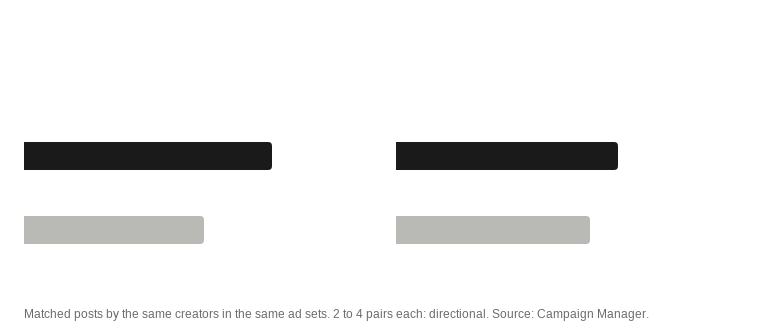
- Show the work, not the features. In one software campaign, posts built around a real use case drew 38% more sign-ups than posts by the same creators that listed product features. Posts that named no features at all drew 68% more site clicks.
- Sell the payoff. Posts that sold the outcome drew 14% more sign-ups and 24% more engagement than posts walking through the steps.
- Name the product late. In the best-performing posts, the product showed up about three-quarters of the way through, after the story. In the weakest, it showed up halfway.
Does follower count matter for B2B creators?
Less than most people think. Audience fit predicts results. Follower count doesn't. The biggest mistake I see is judging B2B creators like consumer influencers. In consumer you go big. In B2B you go exact.
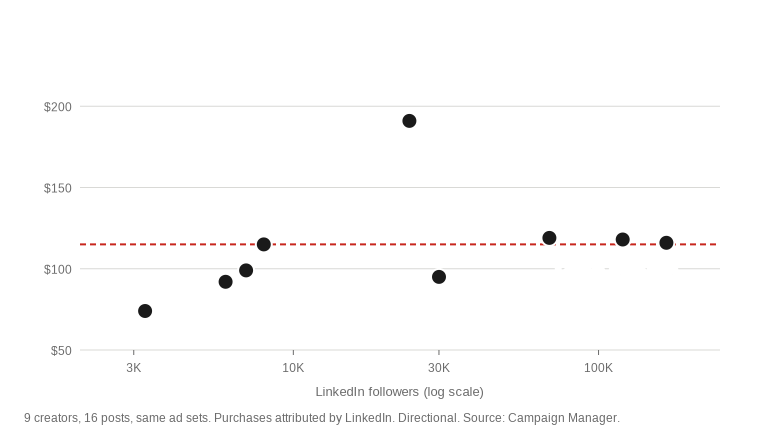
In that same software campaign, across 16 sponsored posts, follower count didn't predict cost. The smallest creator, at about 3,300 followers, delivered the cheapest attributed purchase of the campaign. The four cheapest all had 30,000 followers or fewer, and the three biggest landed right at the campaign average.
It works in reverse too. With one client, we shifted from bigger creators to narrower, more relevant ones and ran it as an always-on, test-and-learn program. Cost per acquisition fell 54%.
I'll take the right person with 5,000 followers over the wrong one with a million.
How do you choose a B2B creator?
Start with your buyer, then find the people your buyer already listens to. A brand content lead I interviewed on our podcast calls this casting. When you think casting, you stop over-indexing on follower counts and ask better questions. Does this person represent our buyer? Are they tonally right for the brand?
We screen on more than 25 signals, but two levers move results most: casting and content. Get the right practitioner in front of the right buyer, in a format that fits their feed, and the numbers follow.
Three checks I never skip:
- Read the comments, not the view count. Who replies tells you who's listening.
- Check that they're the buyer's actual peer. A security architect talking to security leaders beats a tech generalist talking to everyone.
- Avoid the same five creators every brand books. When everyone crowds the same names, each endorsement means less and prices climb.
For the full vetting checklist we use, see how to cast creators for a B2B buying committee.
How do you work with B2B creators?
Treat it like a partnership, not a media buy. In media, you pay for control. With creators, you invest in partnership. Here's how we run it, from brief to wrap.
Before anyone posts
- Strategy first, then the creator. Nail the objective, audience and message before anyone opens a creator list. Don't pitch a name. Pitch a direction, then cast for it. (More on that in how to cast for a buying committee.)
- Shortlist two to four times what you need. Creators field competing offers, and a verbal yes isn't a commitment until it's signed. I've had a deal fall apart after two weeks of negotiating.
- Agree on terms before legal sees the brief. Usage rights, exclusivity and review rounds stall more programs than creative does. Don't treat experts like celebrities. Industry analysts speak at rival conferences and comment on the news every day, so a four-month blanket non-compete will send the best ones walking. A 30-day restriction on the specific topic protects the brand and keeps the deal alive.
While the content gets made
- Guardrails, not scripts. Lock the must-haves: key message, claims and call to action. Then let the creator say it their way. We cap it at two rounds of feedback per post, with no rewriting the creator's words. Heavy edits are the fastest way to turn a creator post into an ad nobody reads.
- Fit the feed. Use the formats that already work for that creator. A practitioner's text post and a comedian's skit shouldn't follow the same template.
- Give people a reason to act. If you need leads, co-create an offer the audience can't pass up. In one program, a gated page with a genuinely useful offer converted up to 14.3% of visitors. Generic pages with no clear reason to sign up converted under 1%.
- Pair voices. A technical practitioner and a finance or executive voice cover different seats on the buying committee. A brand's own leaders next to independent creators work well too. The outside voices carry trust because they aren't on the payroll.
After it's live
- Amplify the winners. Organic is the spark. Paid is the gasoline. Thought Leader Ads can turn a post from a creator with 20,000 followers into millions of impressions in front of the exact titles you want. Get paid usage rights into the contract up front.
- Go always-on. Once is a sponsorship. Every month is an endorsement. The first project is always the hardest, because everyone's learning how to work together. Retainers lower the cost per post, deepen the creator's product knowledge and can lock in category exclusivity, so a competitor can't book your advocate next quarter. LinkedIn's B2B Institute estimates 95% of potential buyers aren't ready to buy today, so repetition is how you're remembered when they are.
- Test and learn. B2B brands are getting methodical faster than consumer brands ever did. Run matched posts, change one thing at a time, and move budget to what converts.
- Reward results, not views. For lead-gen programs, hybrid deals work: a guaranteed fee plus a promo code, affiliate link or bonus per lead. Pay for commercial impact, not vanity reach.
- Keep the relationships that work. In one program, the three best performers were creators who already had a relationship with the brand. Conviction over convenience. Rebook the people who care.
And build in buffer. Creators are people, not placements. Schedules slip and plans change. Chaos is part of the contract.
The bottom line
B2B creators are the people your buyers already trust, publishing where your buyers already spend their working day. Pick them for who they reach, not how many. Give them room to sound like themselves. And stay with them long enough for the repetition to work.
Frequently asked questions
What are the main types of B2B creators?
Practitioners and subject matter experts, content creators, business personalities and entertainers. They are defined by what they do, not by follower count. A practitioner can have 5,000 followers or 200,000.
What content works best for B2B creators?
Useful content in the creator's own voice, built around a real use case and the payoff, with the product in a supporting role. In our campaigns, use-case posts beat feature lists and outcome posts beat step-by-step how-tos.
Is a B2B creator the same as a B2B influencer?
Mostly, yes. The terms overlap. "Creator" puts the focus on the person making the content, and it is the word LinkedIn uses in its products.
How many followers does a B2B creator need?
There is no minimum. In our campaigns, follower count has not predicted results, and the smallest creator has sometimes performed best. Audience fit matters more than size.
Where do B2B creators post?
Mostly LinkedIn, because the audience is there for work and brands can target by job title and company. Many also run newsletters, podcasts or YouTube channels.
Related terms
Go deeper
See every term in the LinkedIn and B2B creator marketing glossary.
About the author
Brendan Gahan has worked in creator marketing since 2006. He is the co-founder and CEO of Creator Authority, the first LinkedIn influencer marketing agency, now part of Billion Dollar Boy. Creator Authority is a member of the LinkedIn Marketing Partner Program. He has been quoted in the Financial Times, Digiday, Ad Age, The Wall Street Journal, Business Insider and Tubefilter. He was named one of LinkedIn’s Top 10 Voices in the Creator Economy in 2022. More about Brendan.
Sources
- Brendan Gahan on LinkedIn: Notion Faces with Snoop Dogg (January 2025)
- LinkedIn and Interpret: Meet the SMB (survey of 4,287 SMB decision-makers, June 2024)
- LinkedIn: Helping brands engage and influence buyers (October 2024, GWI survey of 1,716 buyers)
- Demand Gen Report: LinkedIn research on the creator types B2B buyers trust
- LinkedIn: Creator Marketplace and BrandWorks, with 2026 Global B2B Marketing Outlook data (June 10, 2026)
- Social Media Today: LinkedIn tests advanced creator discovery
- Reuters via AOL: LinkedIn deepens video ad push, taps more publishers and creators (August 2025)
- Net Influencer: LinkedIn expands Creator Marketplace search (October 16, 2026)
- Brendan Gahan on LinkedIn: Cast your creators (January 2026)
- LinkedIn B2B Institute: The 95-5 rule
- LinkedIn: Thought Leader Ads product page
- Search Engine Land: LinkedIn's Collaborate with Confidence guide to B2B creator marketing (June 2025)