
What is a B2B buying committee?
By Brendan Gahan · Updated
Definition
A B2B buying committee, also called a buying group, is the set of people inside a company who research, evaluate and approve a business purchase together. It usually includes a champion, a budget holder, end users, and gatekeepers like IT, finance, legal and procurement, plus people who influence the decision without owning it.
Who is on a B2B buying committee?
Most B2B buying committees include five kinds of people. LinkedIn says committees often include six to ten stakeholders. In my programs, the committees we're trying to reach usually run 6 to 12 people.
- The decision-maker owns the budget and signs.
- The champion finds the problem and pushes for a fix.
- Users will live with the product every day.
- Gatekeepers in IT, security, finance, legal and procurement can slow a deal or stop it.
- Hidden influencers shape the decision without anyone targeting them. Executive assistants, chiefs of staff and office managers often test a tool first and bring it to leadership.
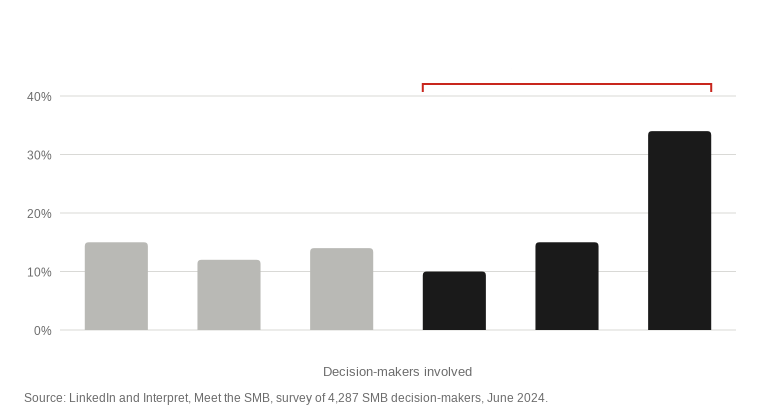
Committees form earlier than most people think. LinkedIn's survey of 4,287 SMB decision-makers found that a majority of SMBs have more than three decision-makers, and that companies with 10 to 50 employees are 18% more likely to involve multiple decision-makers in one purchase. At that size, only 51% of decision-makers buy alone, and only 26% decide in under a week.
The people in the room are getting younger. Forrester reports that Millennials and Gen Z make up 71% of B2B buyers, up from 64% in 2022, and 67% of buyers in deals over $1 million. They do a lot of their own research before they ever talk to sales.
Why do creators work for reaching a buying committee?
Creators work because committee members trust people they already follow more than they trust brand content, and they lean on those people at every stage of a purchase. LinkedIn's VP of Marketing put it simply when he joined our podcast:
"People don't want to hear from brands all the time. They want to hear from people they trust."
LinkedIn's research shows creators matter at every stage of the buying journey:
From three LinkedIn studies with different samples, so read them side by side, not as one funnel.
A lot of it comes down to risk. At LinkedIn's first NewFronts, Matthew Derella, LinkedIn's VP of Marketing Solutions, told me B2B buyers aren't driven by fear of missing out:
"You've heard of FOMO? This is more like FOFU. I just want to make the right call."
Fear of messing up. Multi-year contracts and reputations are on the line, and no one gets fired for choosing the trusted option.
How do you reach a buying committee with creators?
Start with the outcome, pick the tactics that serve it, then cast creators for each seat on the committee. In that order. Most of a campaign's success comes from getting the approach right before anyone opens a creator list.
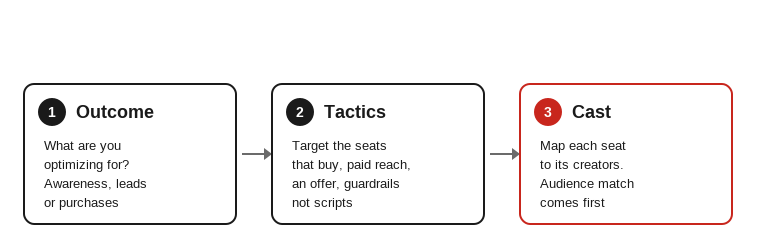
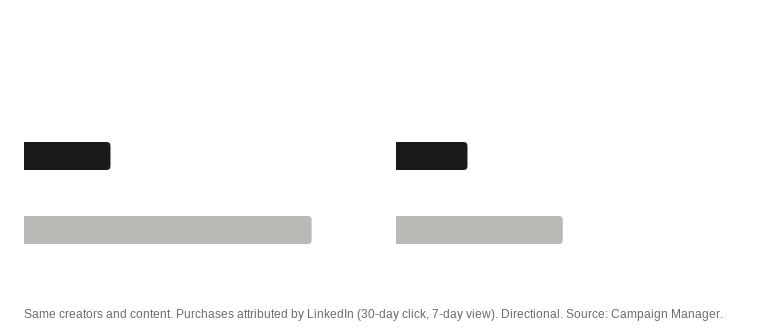
1. Decide what you're optimizing for. Awareness across the committee, leads or purchases. The objective drives cost more than most people expect. In one 2026 software campaign, ads bought on an awareness objective cost $98 per attributed purchase. Ads bought on engagement cost $326. Same creators, different objective.
2. Pick the tactics that fit.
- Target the seats that buy. In that same campaign, ads aimed at founders and partners cost $81 per purchase. Ads aimed at marketing titles cost $189.
- Reach the room with paid. Organic is the spark. Paid is the gasoline. Thought Leader Ads put a creator's post in front of the exact titles and accounts on your list.
- Give people a reason to act. If you need conversions, co-create an offer valuable enough that the audience can't pass it up.
- Use guardrails, not scripts. Lock the key message, claims and call to action. Then let creators say it in their own voice.
3. Cast for each seat. A brand content lead I interviewed on our podcast calls this casting. You stop asking who's biggest and start asking who fits. Different seats listen to different people:
| Seat | What they care about | Who reaches them |
|---|---|---|
| Decision-maker | Risk, ROI, defending the choice | Former executives, analysts, respected operators |
| Champion | Solving the problem, looking good internally | Practitioners in the champion's own function |
| Users | How it works day to day | Hands-on practitioners who show the work |
| Gatekeepers | Security, cost, contracts, compliance | Specialists: security architects, finance and ops voices |
| Hidden influencers | Saving time, making the team's life easier | Workplace and productivity creators |
Then vet each candidate. We screen creators across more than 25 dimensions, quantitative and qualitative.
Audience match outranks everything else. A creator with 400,000 general followers reaches a lot of people who will never sit in the room. A practitioner with 15,000 followers in the right function reaches the room itself.
Price doesn't track follower count either. Category demand, cross-platform reach, exclusivity, usage rights and content type all move the rate. A creator with 30,000 followers in AI can price like a 100,000-follower generalist.
We shortlist about four candidates per deliverable, because a verbal yes isn't real until it's signed.
Don't let one title narrow the list. One enterprise client wanted creators from procurement only, because that's who they said they do business with. But the people who drive those purchases sit across operations and the C-suite too. We ran an audience match and ranked every creator against the client's criteria. Once they saw the overlap in numbers, they widened the brief.
An FYI: your own company has a buying committee too. Legal, procurement and review teams can stall a creator program long after your champion says yes. Agree on usage rights, exclusivity and review rounds before any creator is briefed.
How do you measure creator impact on a buying committee?
Measure at the account level over months, not by the last click. The person who clicked your Thought Leader Ad six months ago might not be the person who signs the contract. LinkedIn's Revenue Attribution Report syncs your CRM and now attributes revenue at the company level, so you can see influence across the account. B2B buying committees don't move fast. Your measurement shouldn't expect them to.
Plan for a long window. LinkedIn's B2B Institute estimates 95% of potential buyers aren't ready to buy today, and most software comes up for renewal about once a year with several stakeholders signing off. That's why always-on beats one-off. Once is a sponsorship. Every month is an endorsement.
One caution. In our programs, most creator-driven conversions show up as view-through. In one software campaign, 96% of sign-ups came from people who saw the ad and later converted without clicking. That's real influence, but attribution windows can over-credit it. If the budget is big enough, confirm the impact with a holdout or brand lift test.
The bottom line
P&G owns the shelf. Google owns the click. LinkedIn owns the room. The room is the buying committee. It's getting younger and more skeptical of brand messaging. Creators are one of the few ways to reach everyone in it, including the people you don't know are there. But it only works if you start with the outcome, cast for fit and show up consistently.
Frequently asked questions
How many people are on a B2B buying committee?
It varies by company size and deal size. LinkedIn says committees often include six to ten stakeholders, and its SMB research found most small businesses have more than three decision-makers. In my programs, the committees we target usually run 6 to 12 people.
Is a buying committee the same as a buying group?
Yes. LinkedIn and many B2B marketers say buying group. Both mean the people who decide a business purchase together.
Why do creators work for reaching a buying committee?
Committee members trust peers and experts more than brands, and creator content gets shared inside companies. That reaches people you never targeted, including hidden influencers.
How do you choose creators to reach a buying committee?
Start with the outcome you want, then map each seat on the committee to the creators that seat already listens to. Vet for audience match first, then performance, category and brand fit, and genuine interest in the topic. Follower count matters less than who the followers are.
Who on the buying committee should creator content target?
Start with the decision-maker and the people who advise them, not only the most obvious job title. Then pick creators whose audiences match each of those roles.
Related terms
Go deeper
See every term in the LinkedIn and B2B creator marketing glossary.
About the author
Brendan Gahan has worked in creator marketing since 2006. He is the co-founder and CEO of Creator Authority, the first LinkedIn influencer marketing agency, now part of Billion Dollar Boy. Creator Authority is a member of the LinkedIn Marketing Partner Program. He has been quoted in the Financial Times, Digiday, Ad Age, The Wall Street Journal, Business Insider and Tubefilter. He was named one of LinkedIn’s Top 10 Voices in the Creator Economy in 2022. More about Brendan.
Sources
- LinkedIn and Interpret: Meet the SMB (survey of 4,287 SMB decision-makers, June 2024)
- EMARKETER: FAQ on B2B marketing in 2026, citing Forrester
- Social Media Today: LinkedIn tests advanced creator discovery
- LinkedIn: Helping brands engage and influence buyers (October 2024, GWI survey of 1,716 buyers)
- LinkedIn: Creator Marketplace and BrandWorks (June 10, 2026)
- Brendan Gahan on LinkedIn: P&G owns the shelf. Google owns the click. LinkedIn owns the room. (July 2026)
- Social Media Today: LinkedIn adds more B2B campaign attribution insight
- PPC Land: LinkedIn enhances Revenue Attribution with company-level measurement (July 2025)
- Brendan Gahan on LinkedIn: The biggest fear in B2B isn't missing out (June 2025)
- Brendan Gahan on LinkedIn: The 95-5 rule and B2B influencers (June 2024)
- Brendan Gahan on LinkedIn: Revenue Attribution Report and creator content (November 2025)
- Brendan Gahan on LinkedIn: Cast your creators (January 2026)
- LinkedIn B2B Institute: The 95-5 rule