
Twitch, is a massive streaming video platform best known for video game broadcasts. It’s also one of the most buzzed about social networks.
In this article I plan to provide a ‘Twitch 101’ – covering why Twitch is important for advertisers, how it works, and the advertising opportunities on the platform.
THE BACKGROUND ON TWITCH
Twitch was founded in 2011 as a spinoff of the live streaming startup, Justin.tv. In 2014 Twitch was acquired by Amazon for nearly a billion in cash. It’s not hard to see why Amazon wanted to pick up the streaming service – it was one of the only successful social media platforms not part of Facebook, Google, or Twitter.
As of January 2020 the average visitor spends nearly two hours a day watching Twitch livestreams. Twitch also boasts over 17.6 Million Daily Active Users and more than 116.3 million unique visitors a month – resulting in an estimated 773 Million monthly live hours watched.
It’s not uncommon to see streamers go live for over 6 hours at a time. For example, dakotaz, a popular Fortnite player has an average stream time of nearly 7 hours.
FUNCTIONALITY
The fundamentals of Twitch are not drastically different from YouTube. There’s a homepage, channels, the ability to search for channels and content categories, and you can subscribe to your favorite channels.
Where Twitch really differs from most social networks is in the role of chat. Chat (or comments if we were to use the equivalent for most sites) is a huge part of the Twitch ecosystem and elevated to the same level as streams themselves.
Viewers engage with streamers (and streamers can engage back) far more than most social networks. The two work together as a continuous loop with participants commenting and engaging with the streamer and streamer engaging and commenting back based on the comments and engagement within the chat box.

Breaking it down the Twitch homepage is called “Discover”, and features several live streams from a variety of categories. On the right hand side you’ll see that there is a leaderboard of recommended channels as well as channels you follow. Next to the ‘Recommended Channels’ section is a ‘Browse’ tab, where users can click to explore streams (live and archived alike) from a variety of channels and categories.

Across the top center is a banner prominently featuring a streamer within a carousel, and when you scroll down there are additional recommended channels and then additional categories to explore. More often than not streams are centered around whatever games are most popular (such as Minecraft or Fortnite).
However, there is a growing contingent of non-gaming content on Twitch such as the “Just Chatting” category, which is mainly just… chatting, as well as music, podcasts, and countless others.

Like YouTube, or most social networks, the home page will be customized based on the channels you’ve subscribed to as well as viewing history.
Within livestream Chats viewers can give streamers a ‘Cheer’ (an animated emote). Cheering is used to support streamers and is useful as a way to get their attention..

The way it works is you purchase each Cheer with Bits, which is a virtual currency you purchase with real dollars, Twitch provides the streamer a share of the revenue Twitch receives from Bits used to Cheer for them. The standard share for Partners and Affiliates is 1 cent per Bit used to Cheer for them. Cheering helps keep the Twitch chat more engaging – highlighting for the streamers who their most enthusiastic fans are, making it easier to thank them, and keeps the chats more interactive.

Users can also follow their favorite streamers and receive notifications of streams by choosing to subscribe or follow their favorite channels.
Subscriptions on Twitch are a bit different from most social networks in that you have to pay a recurring monthly fee (which is split with the content creator and Amazon). As an incentive Subscribers are given a variety of perks and access to the streamers they subscribe to such as specially designed emotes and badges. Subscribers oftentimes get access to exclusive chats and ad free viewing to the streamers feed (although not always).
ADVERTISING ON TWITCH
Advertising on Twitch, when done well, is incredibly impactful because viewers are so engaged. Because the platform is centered around real-time there’s a sense of urgency and audiences forms powerful bonds with the influencers on the site – they trust them and take action based on influencer recommendations.
According to studies the Twitch audience is very open to advertising. Twitch has found that “82% of Twitch users say sponsorships are good for the gaming industry,” and “80% of Twitch users are open to brands sponsoring a specific gamer.”
The forms of advertising opportunities on Twitch is varied, from display and in-stream video, brand integrations in streamer’s content, to creating custom widgets, or even a branded channel.
AD UNITS
I’m not going to spend time going through Twitch’s ad units – this is something you can read about on their advertising site here. Instead I’m going to focus on the exciting stuff – influencer marketing and interactive content, etc.
INFLUENCER MARKETING
Beyond display advertising, brands have the option of doing influencer marketing and working with streamers directly.
So much of Twitch is gaming content, as a result, most advertisers that have partnered with streamers have been gaming companies and they have seen a lot of success.
According to data pulled by Twitch, when “a viewer watched a game on Twitch, their odds of purchasing the game within 24 hours went up substantially.” For some games, the publishers have attributed as much as 25% of game purchases directly back to Twitch influencer marketing.
Top streamers are rumored to getting paid upwards of $50,000 per hour of sponsored gameplay referred to as ‘playthroughs’.
Twitch has a marketplace to connect brands with the long tail of creators as well called ‘Bounty Board’. The Bounty Board, “is a way for creators to browse and accept paid sponsorship opportunities (AKA bounties) directly from their Twitch dashboard.”

Beyond integrations within streams Twitch provides a variety of opportunities for influencer marketing formats. Influencers can discuss the brand, interact with it, and feature it in a video.
Influencer cans also include branding on screen.

The info section is also a great place to incorporate branding – you can link out directly to the brand website and product pages.

BRANDED EXTENSIONS
The most recent addition to Twitch’s advertising arsenal is branded ‘Extensions’.
Launched in 2017, extensions are live apps created by developers that customize channels with Interactive experiences. Advertisers can use extensions to create custom branded apps that enhance the overall Twitch experience for creators and their communities.
Several brands have experimented with extensions with varying degrees of success. Reeses for example did a “Reese’s Easter Egg Hunt” where streamers would play a game and viewers could collect eggs, which would appear as an overlay on top of the stream, for points. The top 5 viewers playing along who gathered the most points by the end of egg hunt were rewarded with 10,000 bits (a virtual good).
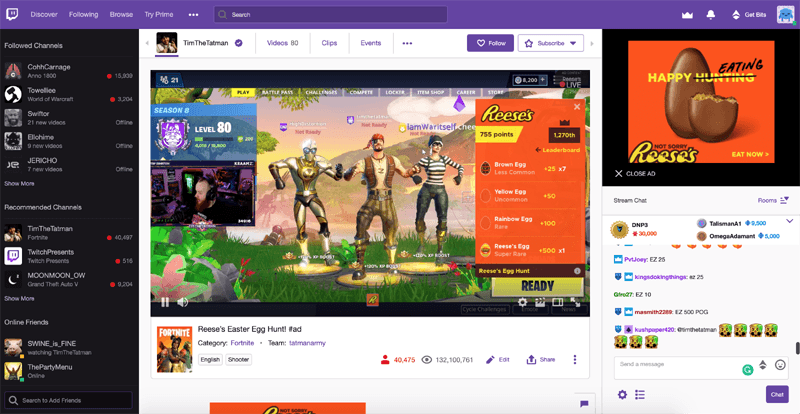
To drive participation Reeses collaborated with several popular streamers including Tim “TimTheTatman” Betar, Ben “DrLupo” Lupo, and his wife, MrsDrLupo to integrate the “Reese’s Easter Egg Hunt” into their streams thereby ensuring engagement with extension.
BRAND CHANNELS
Creating an account for any brand on a social media platform is a double edged sword. On the one hand you can fully control the message and content on the other hand you need to feed the beast and continue to generate content to build an audience.
So far most brands that have done branded accounts have opted to do sporadic stunts. Perhaps the most famous stunt so far on Twitch was Old Spice with their ‘Nature Adventure’ activation.
The ‘Nature Adventure’ was a 3 day long livestream in which a “nature man” was left to wander around the woods and do whatever the viewers please. The way it worked was that options such as “give that antelope a massage,” or “eat strange berries” were overlaid on the livestream and viewers voted on which action they wanted the “nature man” to take – crowdsourcing the gaming style experience.
The effort which was designed to promote Old Spice’s Fresher Collection generated a fair amount of PR buzz and engagement – the activation generated 2.65 million views and 1.4 million chatters participating.
More recently Wendy’s did an activation that earned them the Social & Influencer Grand Prix at the Cannes Lions International Festival of Creativity.
Wendy’s activation, dubbed “Keep Fortnite Fresh” featured an avatar in Fortnite that looked like Wendy walk into in-game burger joints and destroy freezers. The destruction was a statement against frozen beef that competitors use (Wendy’s only uses fresh, and never frozen, beef patties).
The stunt generated a ton of buzz, racking up over 1.5 million minutes watch, and often resulted in other players participating in the rampage. Eventually it became such a distraction the game developers replaced freezers with facilities for fresh burgers.
Wendy’s Twitch activation, dubbed “Keep Fortnite Fresh”
TAKEAWAYS
With Twitch, brands have an incredible opportunity to reach engaged fans who are open to advertising. Whether its display ads, influencer collaborations, brand extensions, or brand channels the platform is incredibly versatile. Although it is often overlooked by brands not endemic to the gaming community it is a platform that non-gaming brands should embrace more often.
]]>While the matches are sure to generate billions of viewers the question remains – in this fractured media landscape will the World Cup, and sports as a whole, manage to remain the media and advertising powerhouse it has historically been?
Initial numbers throughout Europe seem to show that viewership will be down from the last World Cup.
The opening-night match of Russia vs Saudi brought in 9.5 million German viewers – well below the15.9 million that watched the kickoff between Brazil and Croatia in 2014. Similar patterns emerged in France, which had 4 million viewers this year – a decline from 8.7 million in 2014. The British had just over 5 million viewers this year, which was a 7 million-viewer decline from the twelve million fans that watched the opening match in 2014.
Brands are paying big bucks to be aligned with the world’s largest sporting event – according to reports this year’s World Cup show the is set to generate $6.1 billion in revenue, which is $1.3 billion more than the last World Cup in 2014.
The massive awareness and global viewership that the World Cup draws is a unique event and there’s nothing else like it, and, I can understand why brands would tap into these events to advertise. However, I think its clear that the influence of sports as a whole is dwindling – digital influencers, e-sports, and e-sports athletes are chipping away at the market-share of traditional sports.
Sports viewership as a whole is declining (at least on TV).
The NFL saw the 2018 Super Bowl down from a year ago, 8 out of 10 playoff games were down, and pregame viewership was down. Nascar is seeing their fans age out (the average fan is in their late 50’s), and has seen a 45% decline in viewership since 2005.
More than half the MLB’s markets have seen a significant decline in viewers with the Miami Marlins seeing the biggest – a 30% drop. Even the NBA has seen sharp drop in viewership. The 2016-2017 season saw local ratings for 27 of the 30 NBA teams drop and 15 of those experienced double-digit decreases.
Over the years more options have become available to viewers – this could mean that viewers still love their sports and their teams but choose to watch them later or read about them online. However, I think we’re seeing a significant amount of marketshare being wrestled away from sports entirely.
I think that traditional sports are akin to Gillette, before Dollar Shave Club first came on the scene. Previously, they both had a monopoly – then overnight there was a direct to consumer alternative. In this analogy the alternative is e-sports.
More support for this theory is that digital stars have already surpassed traditional athletes in terms of social media popularity.
In April, Tyler “Ninja” Blevins, the famed Twitch gamer/e-sports athlete is now the most engaged athlete on social media. With over 10 million YouTube subscribers and nearly 8 million Twitch followers he’s become a social media phenom, and he’s hardly alone. 8 of the top 10 most recognizable celebs amongst teens today are digital stars. To top it off live sports viewership is declining – the NFL has seen their average per-game audience decline by 17 percent since 2015.
With individual digital influencers building audiences and engagement that rivals traditional celebrity/athletes and TV networks in viewership – this brings up more questions than answers.
What does the mean for the future of sports? Will e-sports games soon overtake the Super Bowl and World Cup in viewership?How will media and advertising dollars shift?
]]>How much money an influencer makes is not a simple question to answer. There are some influencers who make tens of millions of dollars each year, and while they capture the headlines, they are in the minority.
In this post I hope to shed some light on how influencer generate revenue, and what avenues they use to make money.
WHY INFLUENCERS ARE ABLE TO MAKE MONEY
Jake Paul has gone on record that he is going to be a billionaire. I doubt he’ll be a billionaire, although he’s already extremely wealthy; however I have no doubt that some influencer at some point will become a billionaire.
8 of the top 10 most recognizable celebrities amongst teens are youtube stars. These influencers are building (and selling massive businesses). Many are NYTimes best sellers, they’re dominating the box offices. We live in an era where the most engaged athlete in the world (on social media) is a gamer on Twitch.
The scale at which these creators are building audiences is incredible – on Youtube alone there are well over five thousand YouTube channels with at least a million subscribers.
Despite the assumption that being an ‘influencer’ is easy – its not, and even influencers who build large followings can make missteps leading to drastically reduced profits.
There has been a great deal of negative press geared toward YouTube as a result of ads running against content that no brand would want to be associated with – including terrorist videos. As a result, a number of Fortune 500 brands have boycotted the site which has lead to more bad publicity and, undoubtedly, impacted YouTube’s bottom line.
Due to these concerns around brand safety YouTube has clamped down what videos they monetize, and as a result a number of influencers on YouTube have seen their revenue decline dramatically. As part of a number of initiatives to ensure brand safety YouTube has stopped running ads across channels with less than ten thousand subscribers. YouTube has also begun automatically (via an algorithm) demonetizing videos it deems may not be brand safe, and has hired tens of thousands of people to review and vet content. As a result of these measures a number of channels have seen their ad revenue decrease (and in some cases virtually dry up) – resulting in the nickname, ‘The Adpocolypse’.
WHAT PLATFORMS ARE INFLUENCERS MAKING MONEY FROM?
The platforms influencers invest in building an audience on will impact how much money they can make (and where that revenue will come from).
Currently, Instagram is huge for brand placement/brand deals. However, the platform itself doesn’t actually pay influencers a portion of the ad revenue generated by the site. Many influencers, even those with only a few thousand followers, are generating revenue via brands looking product placement integrations. A recent study estimated that there was over $570 million spent globally by marketers for influencer marketing on Instagram last year.
A number of platforms such as Famebit, Reelio, etc have created marketplaces where the long tail of influencers can promote brands in exchange for product or money.
YouTube has consistently been one of the more in demand social networks for influencer marketing. The platform is unique, with ads are run automatically and creators getting a percentage of the ad revenue they generate off their viewers (for channels with over ten thousand subscribers).
The way YouTube ads work is something like this:
- Ad revenue is split 45/55 in favor of the creator
- Most creators generates $2-3 CPM’s
- Generally around half of those views are monetizable
- If part of an MCN, then a percentage is paid to the MCN
It is worth noting that select creators are pulled into ‘Google Preferred’ and their inventory is sold direct by YouTube at a much higher CPM.
I personally have noticed that YouTube lends itself to creating deeper connections between viewer and content creators (something I’ve written about extensively here). As a result, YouTube influencers tend to be able to build up their own brands much easier than other platforms – the connection they have with their audience tends to be much stronger, which allows creators on the platform to better convert viewers to sales.
Twitch is also quickly growing as a profitable platform for influencers. The platform also pays influencers a portion of the ad revenue they generate from viewers, and Twitch streamers can generate brand deals. However, I think Twitch is potentially one of the most ‘creator friendly’ platforms because it has a built in subscription model where they can collect monthly dues from their most dedicated viewers. As a result Twitch is providing a lot more steady income for influencers.
There are other platforms influencers cultivate audiences upon and are monetizable. Blogging was really the first ‘digital influencer’ platform and is still a popular one. There are pinterest influencers who are paid to pin content by the top brands, and recently Musically has grown in popularity – creating a Vine Like resurgence of short form content influencers. Other platforms include Snapchat, YouNow, Tumblr, etc. With the exception of YouNow influencers are not being paid a portion of the ad revenue they’re audiences generate.
YouNow is worth noting because influencers can monetize through a newly launched cryptocurrency, as well as viewers buying digital gifts, of which the influencer gets a portion of the sale price.
Overall, I feel as though YouTube and Twitch are probably the most powerful and sustainable influencer marketing platforms for two reasons:
1) Creators are able to generate revenue from ads and/or subscriptions
2) Content tends to be longer form which leads to deeper connections between viewer and creator. Viewers feel as though they’re much more than ‘just a fan’, that the relationship is akin to a friendship.
Many YouTubers regularly ‘vlog’ and share personal details about their lives – viewers see their friends, family, pets, homes, and even the creator’s ups and downs. Much of the same information is commonly shared on Twitch as a result of so many hours streamed.
AVENUES FOR INFLUENCERS TO GENERATE REVENUE
Regardless of platform, or platforms, influencers build a following upon – once they have an audience there are a number of avenues available to them to monetize their fan base. I’ve written about influencer monetization a bit in the past, and while the assumption tends to be influencers only generate money through brand deals, in actuality there are a number of options out there. Notably, display ad revenue and brand sponsorships are quickly becoming a smaller piece of the revenue pie for most creators.
Outside of direct platform ad revenue, here’s some common ways influencers generate money:
-Appearances and tours
-Building companies
-Merchandise
-Patreon
-Affiliate links/sales
-Writing books
-Making movies (Direct to consumer & studio films)
-Developing apps
APPEARANCES AND TOURS
Much like bands go on the road and sell tickets to concerts to generate revenue, more and more influencers are touring (whether
or not they’re musically inclined) and charge fans to come join them. Most recently YouTuber power couple Trisha Paytas and ason Nash will headline a show dubbed Trisha & Jason Are In Love – according to Tubefilter, “tickets begin at $20, though all-access VIP seats are available for $250 — including a pre-show pizza mukbang (or binge-eating session) with Paytas and Nash, exclusive merch, a photo, and autographs. $60 and $150 ticket options are also available.”
Trish and Nash are hardly alone – vlogger Tyler Oakley launched they wildly popular “Tyler Oakley’s Slumber Party” tour featured Tyler entertaining audiences in various skits and interactive audience segments. The Digitour has been ongoing for nearly a decade and featured a number of musician influencers touring together and performing. Influencers with older demographics have even been celebrity guests at nightclubs – for example Dom Mazzetti of BroScience fame hosted ‘Girls Night’ at a nightclub in Orlando.
BUILDING COMPANIES
Some influencers have tapped into their vast, and highly engaged, audiences to help launch major companies. Michelle Phan, a well known makeup and beauty YouTuber built a beauty subscription service to launch iPsy which has raised $100M. Director/Vlogger Casey Neistat went so far as to build his own Snapchat like social network, Beme, which he sold to CNN in a deal reportedly worth $25 million.
MERCHANDISE
Virtually every major influencers is selling T-shirts, hats, hoodies, etc. Merchandise has become so big many influencers have begun to expand their product lines beyond simply promoting their channels and built out full fashion lines. Tubefilter did a great post covering influencer clothing lines here.
It is worth noting merchandise can expand well beyond clothing, with many influencers have expanded to a variety of products. For example fitness influencers are selling supplements, workout gear, and even fitness program. YouTuber/surfer Ben Gravy even collaborated with Catch Surf to create his own signature surfboard. Whatever and influencer is interested in, odds are they’re productizing it somehow.
PATREON
Patreon has quickly become an alternative platform for influencers to generate revenue. Patreon is a platform that empowers creators to run a subscription content service – It allows artists to receive funding directly from their fans, or patrons, on a recurring basis or per work of art. A number of creators are using the platform to ensure a steady stream of income and enticing fans to subscribe (and donate) but providing exclusives only for Patreon users.
AFFILIATE LINKS
Amazon has an affiliate program for influencers to promote any products posted to Amazon. They generate a percentage of sales revenue with any referral resulting from the traffic they drive.
BOOKS
From Lilly Singh to iJustine, Tyler Oakley and countless others influencers have been flooding the book market – over the last five years, over a dozen major YouTubers have hit the NYTimes best sellers list. Influencer book deals have become so common that the publisher at Atria launched Keywords Press, a partnership with United Talent Agency to showcase digital influencers.
MOVIES
Influencers developing movies really kicked off with Camp Takota in 2014, starring the ‘holy trinity’ of Hannah Hart, Mamrie Hart, and Grace Helbig – the straight to digital movie kicked off a wave of influencer driven movies. Today, with the advent of YouTube Red, influencers starring in movies has become commonplace. A few other examples include The Vlogumentary, Smosh: The Movie, and The Thinning.
Perhaps, most notably John Green, one half of the VlogBrothers, co-founder of Vidcon, and YA author has had several of his books optioned and produced into major motion pictures. One book of his – ‘The Fault in Our Stars’ which was made for just $12 million and opened number one in the box office with a $48.2 million opening weekend. TFIOS went head to head with Tom Cruise’s Edge of Tomorrow, the same weekend, and beat out the sci-fi thriller that cost 15 times as much to produce.
THE ROLE OF FTC AND DISCLOSURE GUIDELINES
Regardless of who an influencer may work with it is incredibly important for them to know that they must disclose any relationship they have with a brand – this is the law.
According to the FTC:
An endorsement must reflect the honest opinion of the endorser and can’t be used to make a claim that the product’s marketer couldn’t legally make. In addition, the Guides say, if there’s a connection between an endorser and the marketer that consumers would not expect and it would affect how consumers evaluate the endorsement, that connection should be disclosed. For example, if an ad features an endorser who’s a relative or employee of the marketer, the ad is misleading unless the connection is made clear. The same is usually true if the endorser has been paid or given something of value to tout the product. The reason is obvious: Knowing about the connection is important information for anyone evaluating the endorsement.
Transparency between an influencer and their audience is critical. If an influencer is being paid or given free product they must make their viewers aware of this relationship. Historically, what qualified as disclosure was a bit murky – influencers didn’t know whether simply saying that a brand provided them with free product, if it had to be written, etc.
Luckily, platforms have since stepped in to help standardize things. Facebook, Instagram, and YouTube have all developed tools to simply automate disclosure.
WHAT’S NEXT FOR INFLUENCERS?
Like I said at the top of this post – I think we’re not far off from seeing the first influencer billionaire. Digital influencers have a direct line of communication to fans and their rapidly exploring monetization models. With their lean, startup-like approach, where they are acting as talent, distributors, and producers they’re able to move swiftly and potentially outpace much larger corporations. Furthermore, with the rise of ecommerce and a multitude of monetization opportunities they’re able to launch brands quickly, generate revenue, and apply learnings to get better and better at making money.