When chess was invented the inventor presented it to the king. The king immediately fell in love with the game.
He offered the inventor whatever he wished.
The inventor asked that a grain of rice be set on the first square of the chess board then double on each subsequent square. He demonstrated it briefly – two grains on the second square, four on the third, and so on.
The king agreed. He thought he’d gotten a bargain and ordered his treasurer to pay the inventor.
After a great deal of time passed the inventor returned. He complained to the king that he wasn’t given his reward.
The king called upon the treasurer.
“Why has the inventor of this brilliant game of chess not been paid!?”
The treasurer explained it was impossible.
By the time you were half way through the chessboard, the amount of rice required was more than the entire realm had or could even afford. The gift would empty the royal coffers and put the entire kingdom in debt.
What does this have to do with social media and advertising?
The entire industry tends to measure success in large numbers. We launch campaigns and watch to see how many views, comments, engagement, or impressions we generated. How did we do compared to our competitors?
There’s nothing inherently wrong with this approach, but there is an unintended consequence.
We never want to start small. We make the same mistake as the king – we can’t believe that starting with so little can lead to so much.
How many times have you heard (or asked for) this?
“We want at least a million views!”
If an agency ended up getting 10 views on a YouTube video when the goal was a million, I think we all know what would subsequently happen. The agency would be viewed as failing to hit their KPIs and most likely let go.
While it’s counter-intuitive, starting small is the way to generate massive results in the long run.
The formula is continued attempts + consistent refinement.
Using the allegory of the king and the chess board, it’s how one grain of rice slowly grew to the net worth of the entire kingdom.
A group of scrappy filmmakers, i.e. influencers (implicitly or explicitly) understand this. They’ve become one person media juggernauts by implementing it. One of them is ZHC (real name Zachary Hsieh). He’s a 21 year old YouTuber from San Jose, California who’s racked up a billion views and over 15 million subscribers.
ZHC generates prime time TV level viewership.
In the last month he’s reached 5x the audience of a typical ‘Monday Night Football’ viewing, 6X the audience of ‘The Masked Singer’ and more viewers than all episodes of ‘The Last Dance’.
Think about that for a second. In the last month he garnered more views than all ten episodes of the ‘The Last Dance’. That was ESPN’s highest rated documentary of all time. It dominated news and social media for an entire month.
How the hell did ZHC become so huge? His viewership was not happenstance.
ZHC’s success seems deceptively obvious on the surface. His format is MrBeast meets Andy Warhol. Pop art with a stunt.
ZHC takes high-end devices such as iphones, ipads, Tesla’s, and even a bus then paints them. He gifts these beautiful (and expensive) items to unwitting fans or other influencers. The reactions are always priceless.
There’s a formula.
The gifts are expensive. The influencer guest appearances are top tier. He’s featured the single largest YouTube creator PewDiePie. Addison Rae who has the second largest following on TikTok. He’s collaborated with Marshmello, as well as, Charli D’Amelio who has over 70 million followers on TikTok. The reactions he captures create a halo-effect of elation.
It all seems very obvious – gather big stars and give them expensive gifts… However, unless you dig into his back catalogue, you won’t see his hundreds of videos that were the foundation for today’s “obvious” success. Like most ‘overnight’ successes ZHC has been grinding it out for years. He posted his first video 4 years ago. By the end of his first year on YouTube he’d posted 50 videos.
Guess how many subscribers he had? 1,011.
Can you imagine working nights and evenings for a year and only have 1k subscribers to show for your efforts?
ZHC didn’t launch with his format fully defined and community in place. The process took time. Trial and error. We can learn a lot about the process from his work. Zach’s early videos were straightforward tutorials on how to draw various comic book characters.
Over time Zach began experimenting.
He slowly inserted more and more of his personality into videos.
After 40 tutorial videos he finally did a video with himself as the focus (vs his art). That first video was “3 tips for getting lots of instagram followers”. The video was one take. He was awkward and rambling at times. The backdrop was just his living room with Zach seated on the couch. That’s it. Watch the video. Could you ever imagine that awkward guy would one day have 15 million subscribers?
The experimentation continued. You see an evolution in slow motion.
He methodically incorporated learnings into his videos.
Zach’s 50th video was “My Inspirational Artists Journey Story”. It was his first attempt at inspirational content. He shared his struggles with school and how art became his salvation. It gave him confidence.
His 63rd video was a ‘challenge’ video – DRAWING 1000 FIGURES IN A DAY?!. It generated more views than his typical videos and he saw the power of integrating stunts.
A month later he did a reaction video. PewDiePie (who has over 100 million subscribers) had stumbled upon a piece of ZHC’s art. Zach filmed a reaction video to PewDiePie’s commentary. This was Zach’s first time featuring another influencer in his video and it got nearly 8 times the viewership he typically got.
He continued experimenting and applying learnings into his repertoire. It took three years before he’d refined the formula to what it is today. And his views have skyrocketed.
This was not slow linear growth – always a little up and to the right. This was the growth Buffett demonstrated in the allegory of the king and the chess board.
Small at first, then massive.

ZHC’s efforts compounded.
He went from averaging ten thousand monthly views in 2017, to one hundred thousand in 2018, to 5 million in 2019. Now ZHC averages 100 million views a month.
So how does this apply to advertising?
As much as the ad industry is skeptical of influencers, there’s much to learn from them.
While we want to create a perfect ad that enters into the pop-culture lexicon. The harsh truth is the world is not waiting for our perfectly produced vision. We must start by creating and then applying learnings to improve.
Rumi, a 13th Century poet said it best “as you start to walk on the way, the way appears.”
That’s the long-term solution. Constant refinement and feedback.
ZHC implemented this process. He consistently created videos. He’d implement small experiments, and apply the lessons learned. He slowly stacked incremental wins on top of wins. Inspiration. Storytelling. Collaboration. Challenges. Surprise and delight. ZHC worked to identify his personal approach.
The formula is continued attempts + consistent refinement.
Quantity to lead to quality.
]]>His story begins when he was, “found by James and Brian under their porch, soaking wet, injured from what appeared to be an attack from an alley cat. They took Toby in, thinking he had no chance to live from his injuries, but miraculously, Toby recovered.”
Sounds like a typical feel good story, right?
Not exactly.
James and Brian, decided to “put Toby at risk for their personal gain.” If $50,000 in donations wasn’t received by June 30th, 2005 Toby would be killed. All this was laid out on their website SaveToby.com.

This wasn’t a fundraiser to nurse the bunny back to health. Toby had already recovered from his injuries.
This was a ransom.
If people didn’t donate $50K Toby would be killed. He’d be finito. Whacked. Under the sod.
Photos on SaveToby.com punctuated the rabbit’s grim situation. They showed Toby in a frying pan, on a plate, and even lounging on a cutting board. As if that wasn’t macabre enough there were recipes for how to cook rabbit.

People were PISSED.
Animal rights activists inundated GoDaddy, the site’s hosting platform, with complaints. Paypal, which was being used for donations, was deluged with calls to cancel the site’s account.
People felt compelled to drive awareness of this injustice.
The debacle became a national story. The Washington Post, Chicago Sun-Times, New York Post, ABC World News Tonight, and NBC Nightly News all covered it.
What do you think happened next?
Activists must have succeeded in the site and paypal getting shut down, right? Certainly the public pressure became too much, right? Wrong.
Save Toby became a phenomenon.
The outrage only led to more awareness.
James and Brian got a book deal with Kensington Publishing (you can still buy it on Amazon today). They got their ransom, and then ratcheted up their demands again. Soon Toby was going to die if they didn’t hit 100k in book sales.
The fight to shut down SaveToby.com backfired.
Well intended outrage only abetted Toby’s would be executioners by driving more awareness of their cause. That awareness led to more donations.
Why did they think their public outcries would work?
Jonah Berger, author of Contagious, studies online virality. He demonstrated that, “content that evokes high-arousal emotions (i.e., awe, anger, and anxiety), regardless of their valence, is more viral.”

In sum, content that elicits a physical reaction is more likely to get shared than content that does not.
For example, let’s imagine you watch one YouTube video and your jaw drops as you scream ‘that’s horrific!’. Then you watch a second YouTube video, and you shrug your shoulder. Which do you think you’re more inclined to share, subscribe, comment, or like?
Online our behaviors are predictable.
The more angry something makes you, the more likely you are to engage with it.
We intuitively understand this.
What we’re less aware of is the impact our reactions have. It makes us feel better to give a self-righteous response.
We perceive responding as furthering our cause. Unfortunately for us, that response generally aid’s the other person’s cause.
Why does this matter?
People know this and weaponize it against us.
On a daily basis we’re bombarded with messages from brands, trolls, news outlets, politicians, and pundits.
Marketers show you awe inspiring feats of athleticism to drive positive brand association. Trolls make hateful comments pissing you off and instigating a response. The news sensationalizes negative stories creating anxiety and keeping you watching in suspense.
In the case of SaveToby.com, the kidnappers elicited outrage and the resulting outcry only furthered their agenda.
Did animal rights activists set out to aid the owners in making fifty grand and getting a book deal? Of course not. Why would they want that? But, that’s exactly what they did.
It feels counterintuitive to bite your tongue. Before returning fire to some troll with a brutal comeback ask yourself this question.
Am I furthering my goals by reacting or am I furthering someone else’s?
What can I expect to happen by reacting vs holding back?
Who is benefiting from my response?
]]>It doesn’t sound like a big deal… but it is.
$135 billion dollars (to be exact). That’s how much revenue is expected to be generated in e-commerce sales via livestreams in China this year.
Last year live-streaming was 1 of the top 3 most used tactics used by marketers in China. With Covid19 audiences, competition, and uses have increased.

Alibaba owned ‘Taobao Live’ increased 7X in first-time customers. Pinduoduo’s live-streaming views grew 5x in March (month over month).
In February users averaged 120 minutes watching livestreams on Douyin (compared to 89 minutes with other content). On Bilibili a similar trend emerged. On average, users watched 190 minutes of livestream content and 105 minutes of other content.
The number of industries flocking to livestreaming to drive sales has been mind-bending.
JD.com partnered with DJ’s to host weekly livestream performances. Alcohol brands sponsored the events and viewers could purchase with a single click. One whiskey advertiser increased sales 70 percent. Beer sales of another partner increased 40 percent.

On Douyin (ie TikTok in China) one livestream hosted by Luo Yonghao an entrepreneur and digital personality, drove $15.5 million in sales and 48 million viewers all in a 3 hour time span.
A Taobao live-streamer, Austin Li, generated 16 million viewers to watch (and purchase) his lipstick.

Even the farming industry has turned to live-streaming.
With traditional supply lines decimated due to Covid19, live-streaming has become a lifeline. Taobao now has over fifty thousands farmers live-streaming. They’re selling their crops direct to consumers.
“Growers who had once sold 90% of their products offline have now flipped to selling 90% online. Live-streaming has not only helped the industry weather the crisis—it’s forged an entirely new way of business that is likely to continue long after the pandemic is over.”
MIT Technology

China has mastered ‘shoppertainment’.
It seems as though each week there is a new streaming record being broken, new use, or new sales record. With dollars and audiences so massive, it’s a foregone conclusion we’ll see attempts by brands and platforms to replicate the habits and features here in the US.
]]>However, it has one major blindspot.
The piece focuses solely on influencers suffering due to loss of advertising. This is true. Influencers are losing ad revenue. However, creators have been developing massive brands and monetizing their fans directly for years. For many creators advertising is the smallest source of revenue.
I find this ironic given Kylie Jenner is the featured influencer. Jenner is a billionaire after developing her own beauty brand, Kylie Cosmetics.
Merch has always been big amongst influencers. Influencers have been broadening into developing their own products. For example, Shane Dawson and Jeffree Star sold over a million of their Conspiracy Theory palettes. Countless creators have developed apps and games. Movies, music, and tours are common as well.
Services like Cameo and Patreon are allowing creators to monetize their fans directly. YouTube, Twitch, Facebook, and TikTok all have some form of digital gifting that allows fans to tip creators with real money. Fansa re more than willing to pay for content from their favorite creators.
My assumption is that the Covid19 crisis will hasten influencers independence from brands. Creators who had previously avoided creating their own march or subscription products are likely to explore those opportunities now.
The author states, influencers who can’t “prove their value to brands may find that their place in the industry grows precarious.”
I disagree.
Influencers who can’t monetize their own fans themselves may find their place in the industry precarious. Those creators that can provide value to their fans will be just fine. They’ll be able to generate revenue independent of brands and advertisers.
]]>First reported by The Information, the YouTube version of TikTok has been dubbed ‘Shorts’. The TikTok competitor is rumored to live within the existing YouTube app and take advantage of YouTube’s music licensing deals.
This doesn’t come as a total shock. YouTube has been quietly incorporating TikTok style features for some time now. Over the last month or so YouTube’s app has changed features that mirror TikTok in three big ways:
1) Emphasizing categories vs search
2) Curating content experiences
3) Providing content prompts
CATEGORIES VS SEARCH
Last week I wrote about how YouTube shifted its emphasis from search to more curated experiences (like TikTok) and was bracketing content categories in a manner very similar to hashtag challenges.
Historically, YouTube placed an emphasis on search (it being the second largest search engine). Recently the search feature was changed to ‘explore’. Now when you click on ‘explore’, there are categories of content featured that site above recommended and trending videos. Previously the app had trending and recommended content. This mimics TikTok’s has ‘discover’ feature.
At the top of TikTok’s discover page is curated content categories, hashtag challenges, and list of trending hashtags.
YouTube is evolving from specific video recommendations to an emphasis on broader categories.

CURATED CONTENT
When you click on a content category there’s a header and curated list of videos to watch. This is layout is similar TikTok.
On TikTok if you click through to one of the content categories or hashtag challenge there’s a banner across the top, description of the content and then a curated list of TikTok’s to watch.

PROMPTING CONTENT CREATION
YouTube seems to be taking cues from TikTok’s hashtag challenges. TikTok’s hashtag challenges act as prompts for users to create content. Creators often jump on the challenges in hopes of being featured high up on the challenge pages and getting exposure.
YouTube has begun experimenting with its own hashtag challenges.
Due to Coronavirus millions have been forced to stay home. YouTube helped get the word out by launching the Stay Home #withme challenge. The Stay home #withme challenge invited creators to make videos around activities anyone could do from home.
YouTube consolidated all #withme videos under the hashtag (much in the same way TikTok does). YouTube doesn’t typically create or promote specific content asks from its community. In making this change YouTube mirrored hashtag challenges.
These are big shifts for YouTube.
Search has been such a big part of the site, that playing a larger role in promoting ’discovery’ seems as though the platform is looking to modify behavior in a significant way. Additionally, YouTube has historically been passive in content creation. With the launch of #withme YouTube clearly provided a prompt for the broader community.
These changes, which are influenced by TikTok, are likely providing data to YouTube to inform their ‘Shorts’ launch.
]]>Micro isn’t better. Better is better.
Touted as having higher engagement rates, lower pricing, and more credibility than their ‘macro’ counterparts micro influencers are the hottest category of creator to hire.
This is silly.
Micro-influencers being better or more effective is not a universal marketing principle. Leveraging micro-influencers is a tactic, and one that is far from a silver bullet.
The rise in popularity of micro-influencers coincides with the rise of influencer marketplaces. Influencer marketplaces are self-service platforms where brands share opportunities for creators to do paid endorsements.
Working with micro-influencers via marketplaces may seem to be a scalable way to do influencer marketing but it is wrought with issues.
First and foremost there is the common misconception that micro-influencers are more engaging. While that is often true that micro-influencers have higher engagement than macro influencers on a per capita basis, that doesn’t mean that engagement translates to a more efficient cost per engagement (CPE) for advertisers.
According to data compiled by Andrew Kamphey of Influencer’s Weekly, it is actually more efficient to work with larger influencers one a CPE basis.
As influencers get bigger their engagement generally declines a bit, but their costs don’t scale at the same rate.

One factor often overlooked in working with influencers is not just the hard costs, but the time spent to manage influencers. Working directly with an influencer that has 10 million subscribers is often just as much work as working with an influencer that has 10 thousand.
Even if you work with influencers via influencer marketplaces, taking the time to review content and managing quality control becomes a huge issue.
Within these market places brands are asking creators to opt into campaigns based on a brief that has been posted. You are not spending time working closely with a creator via meetings and phone calls. Oftentimes a brief is the only thing the creator gets to their hands on to get to know the brand before going on to develop promotions even without the products themselves.
Credibility is a big issue as well (one that I imagine will become a bigger issue as time goes on). Creators looking to make money will need to go from brand to brand, oftentimes working with competitors in the same category.
At the same time the inverse approach, of working exclusively with the top tier influencers isn’t a perfect solution either. Just because some has scale doesn’t mean they’re relevant to your audience.
Top tier creators are often bombarded with brand deals and opportunities. Their ability to invest in a partnership is constrained. You don’t want to work with someone that just won’t or can’t make the time for you.
There is no easy solution and therein lies the opportunity.
Few brands and marketers are willing to put in the time and effort to focus on identifying creators that are truly relevant, then having conversations with them to gauge interest, and then work with them deeply and make them real partners.
As the saying goes, the last mile is always the least crowded.
None of this is rocket science, but like most good things, it takes patience, focus, and a long-term outlook vs looking for quick fix solutions.
]]>The impact that the virus outbreak has had on digital and social media behavior in China, likely provides a look into the future of what we can expect here in the states.
People have changed their behaviors worldwide with more time being spent online as people are forced indoors.
Some trends that we’ve seen emerge in China include the following:
Audience Engagement & Viewership Growth:
Creators in China saw a surge in subscribers and viewership.
One top tier live streamer Austin Li drew a record breaking (for him) 16 million viewers on his first stream this February. He’s not alone in generating a spike in viewership.
A study of 574 accounts across popular video apps Douyin (TikTok in China) and Kuaishou showed creators accruing 100k – 500k followers from January 20th thru February 2nd. One food creator @皮皮教做菜 noted that this time of year he generally sees some growth, but nothing like this. @皮皮教做菜 gained over 1 million followers from a single video.
With people eating out less, food and cooking content saw spikes in demand. People staying at home and wanting to learn to cook lead to Douyin (TikTok) supporting cooking-related content with a Tasty Food Challenge which generated over 10.3 billion views.
Comedic content also saw massive viewership increases. According to data released by Bilibili (a Chinese video sharing site), views of videos tagged with the word ‘funny’ grew by 905 percent between January 23rd to February 5th.
One beauty KOL (influencer) Melilim Fu saw a 10 percent increase in followers over a two week period. According to Jing Daily these aren’t isolated incidents, “those increases are across the board, including engagement and new private traffic followers. It’s very noticeable that people are spending more time bored at home.”
Beyond engaging with influencers, the Covid-19 quarantines resulted in a spike in app downloads. The first few weeks of February resulted in 40% more app downloads than the same time in 2019. Additionally, there were 222 million apps downloaded in China’s Apple app store from February 2nd – 24th. Games topped the list, but educational app downloads doubled as many schools closed down.
Offline Events Come Online
As in person events and social distancing became banned and/or discouraged China brought traditional offline events online.
In February there were at least seven movies slated for theatrical release. With theaters forced to close down due to the virus these releases were moved online. ByteDance, best known as the holding company of TikTok, paid 630m yuan (US$90.8m) for the rights to stream several films across their mobile apps.
Here in the states we haven’t seen the same thing occur yet, but Disney did just announce something similar. Disney is adding “Frozen 2” to Disney Plus three months ahead of schedule.
As people are forced to spend more time indoors they are spending more time online. However, production resources, shoots, some commerce, and brand deals have largely declined or postponed.
Challenges With Content Creation
Because meeting face to face is difficult due to quarantines and social distancing production has been hampered.
People often assume that influencers are one man bands – writing, filming, editing, and participating as talent all on their own. In reality established creators have large teams.
Elijah Whaley, a manager of beauty KOL’s (influencers) in China recently stated that, “it will undoubtedly affect content creators that rely on teams and studios. The immediate effects are more felt with the planned campaigns, which have already been canceled or delayed, especially offline events.”
Here in the states we’ve already seen top tier creators share publicly the impact Covid-19 has had on their production process. The CEO of The Fine Brothers (of react fame) commented in a recent Digiday article that “Two weeks ago, FBE began actively planning for the possibility that coronavirus may force the entertainment company to temporarily close its 25,000-square-foot studio and have its 105 employees work from home.”
Sales & Brand Deals:
Although this may be a time of investment in community building it is likely that many creators will suffer from brand deals being cancelled and/or postponed. Additionally, with factories shut down getting products to consumers could prove to be difficult for some time.
According to Jing Daily:
“Several influencers have shared that their Q1 brand campaigns have all been postponed — many until as late as May. While this is a big blow to their earnings, they will likely make it all back later in the year if they can hold out until then. But the top influencers aren’t too concerned. The popular WeChat account “GQ实验室” says that there are even some positive aspects to this unfortunate moment. For instance, publishing fewer commercial articles gives influencers a much-needed opportunity to create more and better editorial content.”
Streamers in China with their own brands and products are facing a lack of stock and delivery delays. Many streamers are immediately selling out of what few products they have on hand. As a result, many influencers are selling items as ‘pre-sale’ with the promise that they’ll be shipped when manufacturing resumes.
Here in the states we’re already starting to see similar effects. Brand deals are being postponed, and travel influencers in particular are the hardest hit. As BusinessInsider reported, “Travel influencer Lauren Bullen, known as @gypsea_lust on Instagram with 2.1 million followers, said all her paid trips had been canceled.”
While these may be difficult times, it will pass. If anything for those of us here in the states, we can look to China and the trends that emerged to help inform our own decisions and preparations.
]]>Headlines like ‘The Dishonest and Wasteful Practice of Influencer Marketing’ paint influences with a broad brush as money grubbing and eager to take any brand deal coming their way and sell out their audiences along the way.
That’s just not true and doesn’t accurately reflect the majority of my experiences in nearly 15 years of influencer marketing.
Influencers say no and fight for work they believe in.
I personally have experienced influencers walk away from 6 figure brand deals because they didn’t feel it was a good fit, or they felt like they couldn’t do the campaign justice. Oftentimes they genuinely loved the brand, but simply couldn’t take on the workload or couldn’t quite wrap their head around a way to bring a campaign to life.
When working on branded content with influencers, they often say no to client requests and push back in order to fight for what they feel is going to work best. That’s their job. It can be frustrating, but ultimately, I’m incredibly grateful that they do it.
Ultimately, saying no to most opportunities makes sense for influencers.
The connection influencers have to their audience is the lifeblood of their business.
As tempting as it may be to take a nice paycheck in the short term, if it is going to compromise the relationship they have with their audience (real or perceived) they should say no. Brands come and go, but the audience is the renewable resource that keeps their business alive – brand deals or no brand deals.
This isn’t some deep insight, and I’m not saying that all influencers are saints. I have had some incredibly difficult experiences working with influencers. However, by and large, I’ve found my experiences in working with influencers to be extremely rewarding, informative, and effective for the brands.
The reality of influencer marketing is more complex than the knee jerk reaction being made by many marketers writing op-eds at the moment.
Some influencers are more talented or honest or hard working than others, and in many ways influencers have got more in common than a typical creative director than anyone else.
As a general rule they care about their reputation. They want to do work they’re proud of. They want to make work that is fulfilling and recognized by their peers.
For both groups this oftentimes means forgoing short term gains and carefully curating the opportunities they take on in order to create a career with longevity. For Creative Directors you see this reflected in the way many choose to work for more creative shops vs behemoths that pay well but churn out crap. Just like influencers, Creative Directors have a responsibility to push back on clients if that’s what it takes to get great work made.
Generally speaking, neither influencers nor creative directors wants to sell out their credibility for a quick pay day.
As frustrating as the creative process can be, I’d much rather have someone be honest with me about what they believe will work best, and is right than take the money and run.
Objectively, I think we can all appreciate the integrity it takes to say no and push back in the face of overwhelming pressure or walk away from the carrot in the form of a nice payday being waved in front of our face.
]]>
The more things change, the more they stay the same.
Collaboration is, and will always be, a tool to drive growth and build an audience online… rising tides lifts all boats.
The Hype House is an LA mansion TikTok stars formed in December of last year to live and collaborate.
These TikTokers are co-creating content, featuring and promoting one another in an effort to cross-promote one another and collectively grow their audiences. The ideal outcome is an ever expanding audience.
Influencer A has X audience and Influencer B has Y audience. The two promote one another to capture both X & Y audiences and (ideally) capture additional followers in the process.
If history is any indication, the Hype House could be the start of a massive business that may change the course of media.
This fundamental principle of collaboration has been key to influencer marketing, and social media marketing (and expanding ever outward, you could argue for a great deal of success in life in general), since the beginning.
You scratch my back I scratch yours.
Going back to the late 2000’s we first saw this tactic brought to life with the YouTube community in the form of The Station. The Station eventually morphed into Maker Studios, which went on to be acquired by Disney for nearly a billion dollars.
The Station started as a loose federation of YouTubers who came together in the summer of 2009 to share resources and collaborate on content creation in the form of a collective sketch comedy channel.
Working out of a few Venice Beach, CA homes, the groups was affectionately dubbed, A Modern Brat Pack of YouTubers, TheStation was comprised of Shane Dawson, Kassem G, Phil DeFranco, Dave Days, Shay Carl, Lisa Donovan, with cameos from other YouTubers like iJustine.
Before a video was ever launched, their collective YouTube channel, was among the 25 most subscribed channels across all of YouTube. By winter 2009, after only a handful videos had launched, The Station had become second most watched web series.
Eventually, several creators from the original crew parted ways, but LisaDonovan, ShayCarl, Kassem and a handful of others soldiered on. The team moved into crappy offices above a Taco Shop, rebranded into Maker Studios, raised money, became an MCN, began signing YouTube channels to power that MCN, and by 2012 were generating over a billion views a month.
In 2014 Disney came knocking and acquired Maker Studios for $550 million dollars, with benchmarks, that if hit could bring the total earn out to close to a billion dollars.
This isn’t to say that absolutely the Hype House of today will follow a similar path, but I certainly believe that it is possible.
In its infancy YouTube was filled with silly dance and lip sync videos, which made the whole phenomenon easy to discount. In many ways it mirrors the common perception of TikTok today.
However, as the saying goes, “First they ignore you, then they laugh at you, then they fight you, then you win.”
]]>
Twitch, is a massive streaming video platform best known for video game broadcasts. It’s also one of the most buzzed about social networks.
In this article I plan to provide a ‘Twitch 101’ – covering why Twitch is important for advertisers, how it works, and the advertising opportunities on the platform.
THE BACKGROUND ON TWITCH
Twitch was founded in 2011 as a spinoff of the live streaming startup, Justin.tv. In 2014 Twitch was acquired by Amazon for nearly a billion in cash. It’s not hard to see why Amazon wanted to pick up the streaming service – it was one of the only successful social media platforms not part of Facebook, Google, or Twitter.
As of January 2020 the average visitor spends nearly two hours a day watching Twitch livestreams. Twitch also boasts over 17.6 Million Daily Active Users and more than 116.3 million unique visitors a month – resulting in an estimated 773 Million monthly live hours watched.
It’s not uncommon to see streamers go live for over 6 hours at a time. For example, dakotaz, a popular Fortnite player has an average stream time of nearly 7 hours.
FUNCTIONALITY
The fundamentals of Twitch are not drastically different from YouTube. There’s a homepage, channels, the ability to search for channels and content categories, and you can subscribe to your favorite channels.
Where Twitch really differs from most social networks is in the role of chat. Chat (or comments if we were to use the equivalent for most sites) is a huge part of the Twitch ecosystem and elevated to the same level as streams themselves.
Viewers engage with streamers (and streamers can engage back) far more than most social networks. The two work together as a continuous loop with participants commenting and engaging with the streamer and streamer engaging and commenting back based on the comments and engagement within the chat box.

Breaking it down the Twitch homepage is called “Discover”, and features several live streams from a variety of categories. On the right hand side you’ll see that there is a leaderboard of recommended channels as well as channels you follow. Next to the ‘Recommended Channels’ section is a ‘Browse’ tab, where users can click to explore streams (live and archived alike) from a variety of channels and categories.

Across the top center is a banner prominently featuring a streamer within a carousel, and when you scroll down there are additional recommended channels and then additional categories to explore. More often than not streams are centered around whatever games are most popular (such as Minecraft or Fortnite).
However, there is a growing contingent of non-gaming content on Twitch such as the “Just Chatting” category, which is mainly just… chatting, as well as music, podcasts, and countless others.

Like YouTube, or most social networks, the home page will be customized based on the channels you’ve subscribed to as well as viewing history.
Within livestream Chats viewers can give streamers a ‘Cheer’ (an animated emote). Cheering is used to support streamers and is useful as a way to get their attention..

The way it works is you purchase each Cheer with Bits, which is a virtual currency you purchase with real dollars, Twitch provides the streamer a share of the revenue Twitch receives from Bits used to Cheer for them. The standard share for Partners and Affiliates is 1 cent per Bit used to Cheer for them. Cheering helps keep the Twitch chat more engaging – highlighting for the streamers who their most enthusiastic fans are, making it easier to thank them, and keeps the chats more interactive.

Users can also follow their favorite streamers and receive notifications of streams by choosing to subscribe or follow their favorite channels.
Subscriptions on Twitch are a bit different from most social networks in that you have to pay a recurring monthly fee (which is split with the content creator and Amazon). As an incentive Subscribers are given a variety of perks and access to the streamers they subscribe to such as specially designed emotes and badges. Subscribers oftentimes get access to exclusive chats and ad free viewing to the streamers feed (although not always).
ADVERTISING ON TWITCH
Advertising on Twitch, when done well, is incredibly impactful because viewers are so engaged. Because the platform is centered around real-time there’s a sense of urgency and audiences forms powerful bonds with the influencers on the site – they trust them and take action based on influencer recommendations.
According to studies the Twitch audience is very open to advertising. Twitch has found that “82% of Twitch users say sponsorships are good for the gaming industry,” and “80% of Twitch users are open to brands sponsoring a specific gamer.”
The forms of advertising opportunities on Twitch is varied, from display and in-stream video, brand integrations in streamer’s content, to creating custom widgets, or even a branded channel.
AD UNITS
I’m not going to spend time going through Twitch’s ad units – this is something you can read about on their advertising site here. Instead I’m going to focus on the exciting stuff – influencer marketing and interactive content, etc.
INFLUENCER MARKETING
Beyond display advertising, brands have the option of doing influencer marketing and working with streamers directly.
So much of Twitch is gaming content, as a result, most advertisers that have partnered with streamers have been gaming companies and they have seen a lot of success.
According to data pulled by Twitch, when “a viewer watched a game on Twitch, their odds of purchasing the game within 24 hours went up substantially.” For some games, the publishers have attributed as much as 25% of game purchases directly back to Twitch influencer marketing.
Top streamers are rumored to getting paid upwards of $50,000 per hour of sponsored gameplay referred to as ‘playthroughs’.
Twitch has a marketplace to connect brands with the long tail of creators as well called ‘Bounty Board’. The Bounty Board, “is a way for creators to browse and accept paid sponsorship opportunities (AKA bounties) directly from their Twitch dashboard.”

Beyond integrations within streams Twitch provides a variety of opportunities for influencer marketing formats. Influencers can discuss the brand, interact with it, and feature it in a video.
Influencer cans also include branding on screen.

The info section is also a great place to incorporate branding – you can link out directly to the brand website and product pages.

BRANDED EXTENSIONS
The most recent addition to Twitch’s advertising arsenal is branded ‘Extensions’.
Launched in 2017, extensions are live apps created by developers that customize channels with Interactive experiences. Advertisers can use extensions to create custom branded apps that enhance the overall Twitch experience for creators and their communities.
Several brands have experimented with extensions with varying degrees of success. Reeses for example did a “Reese’s Easter Egg Hunt” where streamers would play a game and viewers could collect eggs, which would appear as an overlay on top of the stream, for points. The top 5 viewers playing along who gathered the most points by the end of egg hunt were rewarded with 10,000 bits (a virtual good).
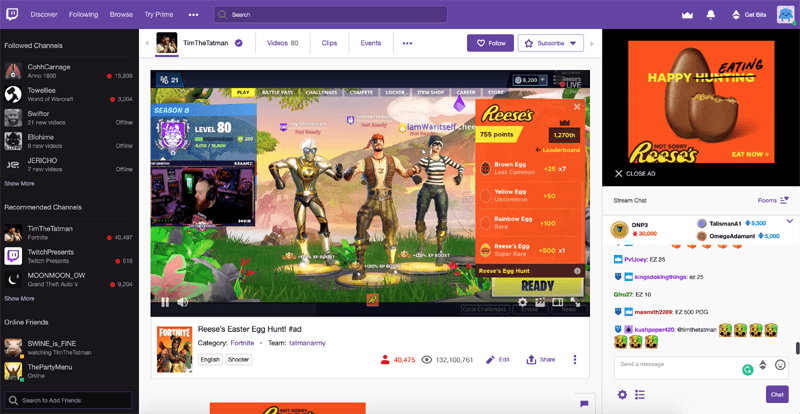
To drive participation Reeses collaborated with several popular streamers including Tim “TimTheTatman” Betar, Ben “DrLupo” Lupo, and his wife, MrsDrLupo to integrate the “Reese’s Easter Egg Hunt” into their streams thereby ensuring engagement with extension.
BRAND CHANNELS
Creating an account for any brand on a social media platform is a double edged sword. On the one hand you can fully control the message and content on the other hand you need to feed the beast and continue to generate content to build an audience.
So far most brands that have done branded accounts have opted to do sporadic stunts. Perhaps the most famous stunt so far on Twitch was Old Spice with their ‘Nature Adventure’ activation.
The ‘Nature Adventure’ was a 3 day long livestream in which a “nature man” was left to wander around the woods and do whatever the viewers please. The way it worked was that options such as “give that antelope a massage,” or “eat strange berries” were overlaid on the livestream and viewers voted on which action they wanted the “nature man” to take – crowdsourcing the gaming style experience.
The effort which was designed to promote Old Spice’s Fresher Collection generated a fair amount of PR buzz and engagement – the activation generated 2.65 million views and 1.4 million chatters participating.
More recently Wendy’s did an activation that earned them the Social & Influencer Grand Prix at the Cannes Lions International Festival of Creativity.
Wendy’s activation, dubbed “Keep Fortnite Fresh” featured an avatar in Fortnite that looked like Wendy walk into in-game burger joints and destroy freezers. The destruction was a statement against frozen beef that competitors use (Wendy’s only uses fresh, and never frozen, beef patties).
The stunt generated a ton of buzz, racking up over 1.5 million minutes watch, and often resulted in other players participating in the rampage. Eventually it became such a distraction the game developers replaced freezers with facilities for fresh burgers.
Wendy’s Twitch activation, dubbed “Keep Fortnite Fresh”
TAKEAWAYS
With Twitch, brands have an incredible opportunity to reach engaged fans who are open to advertising. Whether its display ads, influencer collaborations, brand extensions, or brand channels the platform is incredibly versatile. Although it is often overlooked by brands not endemic to the gaming community it is a platform that non-gaming brands should embrace more often.
]]>